Beyond the Bling: Choosing Hypoallergenic Piercing Metals
Why Choosing the Right Metal Makes All the Difference
Piercing metals for sensitive skin can transform your jewelry experience from painful irritation to comfortable, beautiful wear. The wrong metal choice leads to redness, swelling, and infections - while the right materials allow your piercings to heal properly and look stunning for years.
Best piercing metals for sensitive skin:
- Implant-grade Titanium (ASTM F-136) - Most biocompatible, nickel-free
- Niobium - Pure metal, hypoallergenic, flexible
- Platinum - Inert, durable, naturally white
- 14k-18k Solid Gold - High purity, avoid plated versions
Metals to avoid:
- Nickel-containing alloys (most common allergen)
- Gold-plated or gold-filled jewelry
- Sterling silver (contains copper)
- Surgical steel (contains 8-16% nickel)
Getting a new piercing should be exciting, not a source of ongoing irritation. Yet many people experience red, itchy earlobes or infected piercings simply because they chose jewelry made from reactive metals. Nickel is the most common metal allergy, affecting millions of people who don't even realize their jewelry is the culprit.
The truth is, your body treats certain metals as foreign invaders. When low-quality alloys leach nickel or copper into your skin, your immune system fights back with inflammation, rashes, and discomfort. But biocompatible metals work differently - they're chemically inert, meaning your body accepts them without reaction.
This guide will show you exactly which metals are safe for sensitive skin and which ones to avoid completely. You'll learn to spot the warning signs of metal allergies and make informed choices that protect your health while maintaining the luxury aesthetic you deserve.
I'm Eric Roach Zalori, and through my experience launching Summit Metals Holdings and creating Zalori's jewelry collection, I've seen how piercing metals for sensitive skin require the highest quality materials and craftsmanship. Every piece we create starts with sterling silver as the base minimum, ensuring our customers never compromise on material integrity or skin safety.
Is Your Piercing Irritated? Signs of a Metal Allergy
It's an exciting moment when you get a new piercing or swap out an old piece of jewelry. But that excitement can quickly turn to discomfort if your body decides it doesn't like the metal you've chosen. If you have sensitive ears or an allergy to earring metals, the allergic reaction behaves similarly to other allergic reactions on the skin. So, how do you know if your piercing irritation is a metal allergy, an infection, or just normal healing? Let's explore the tell-tale signs.
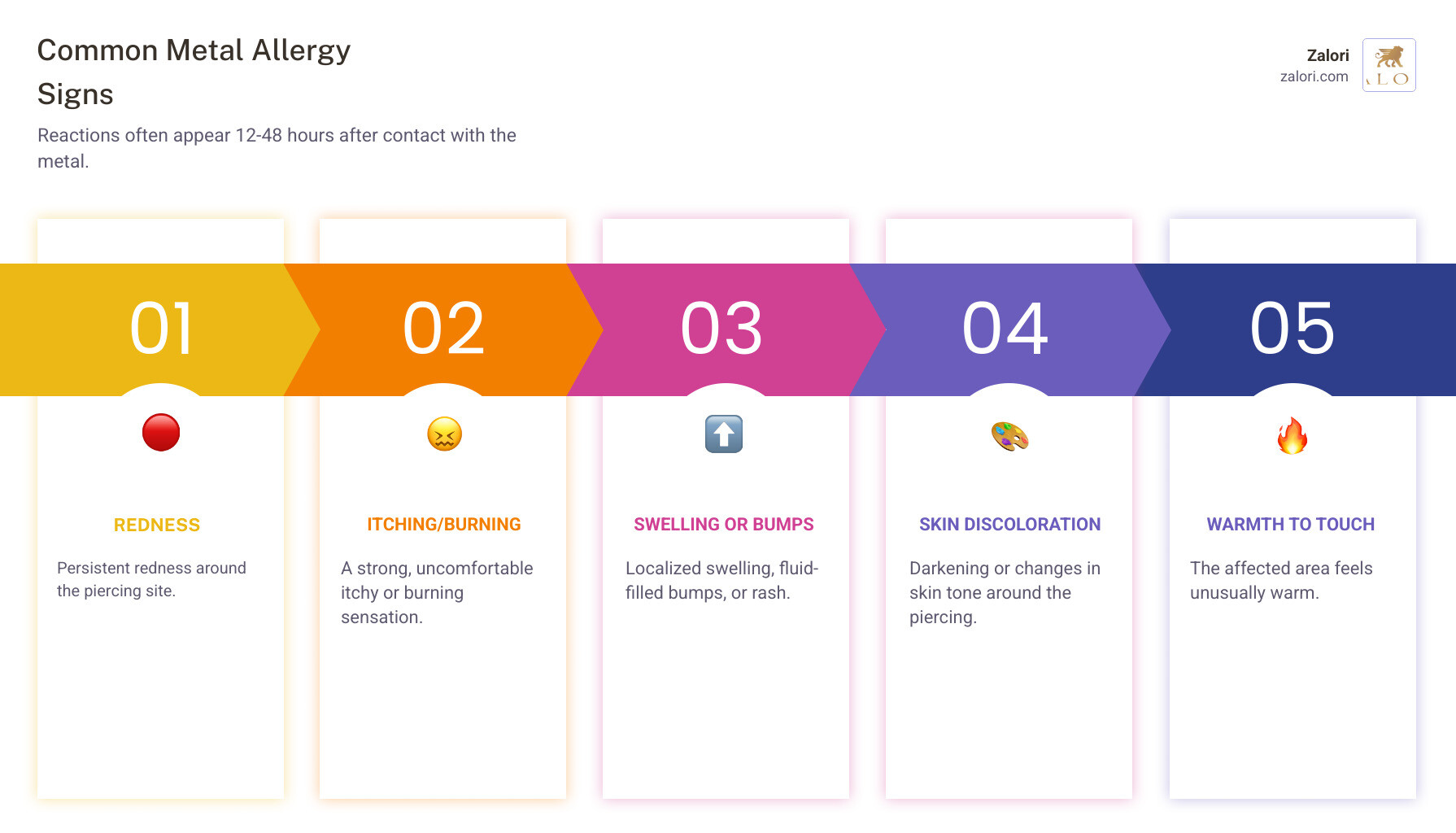
Common symptoms of a metal allergy, often referred to as contact dermatitis, usually appear within 12 to 48 hours after contact with the offending metal. These reactions can range from mild annoyance to significant discomfort:
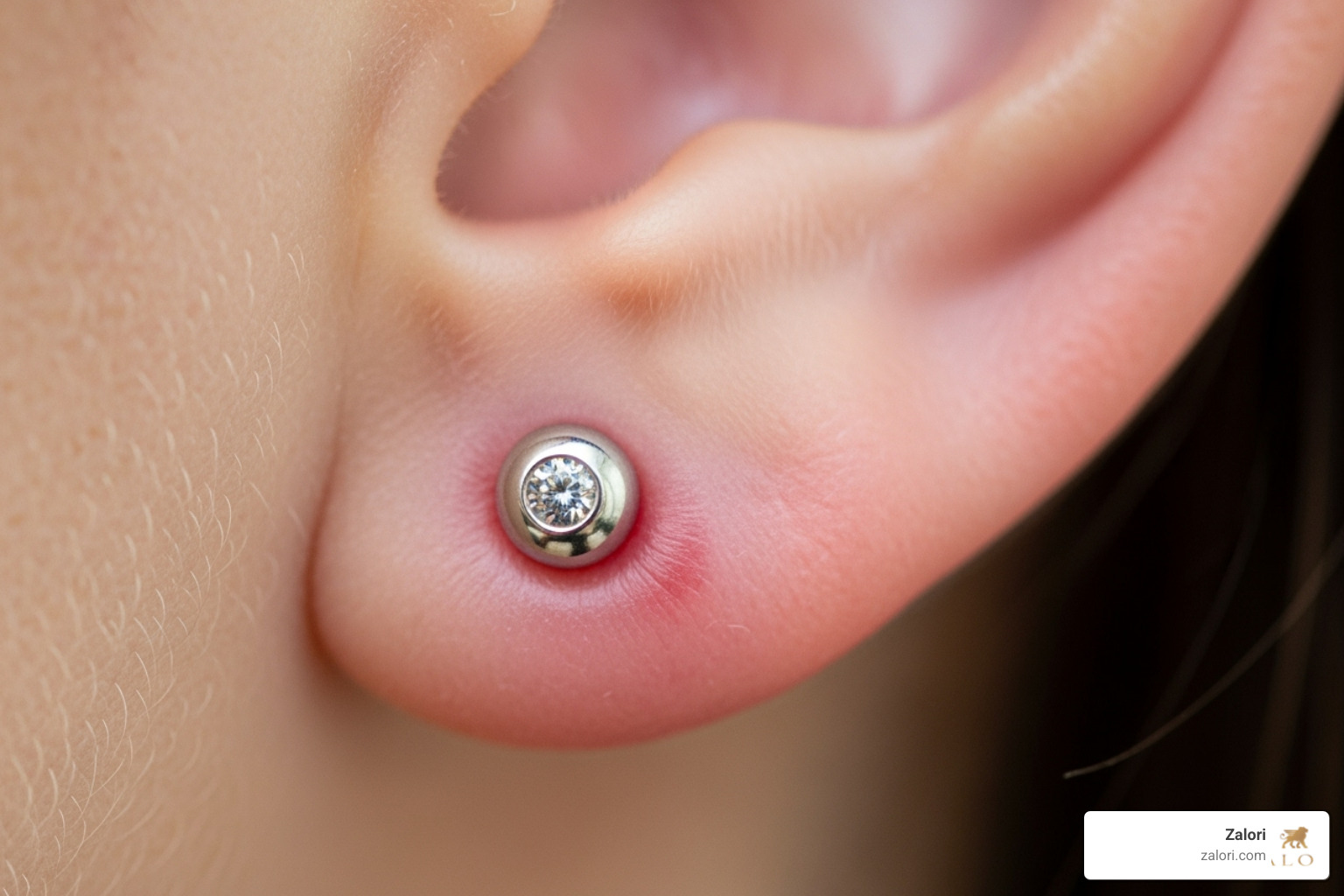
- Redness: The skin around your piercing may become noticeably red.
- Itching: An insistent, sometimes intense, itching sensation at and around the piercing site is a very common sign. Nickel, in particular, triggers allergic reactions resulting in skin redness coupled with itching and skin irritation.
- Swelling: The area might puff up or feel inflamed.
- Bumpy Rash or Blistering: You might develop small bumps, a rash, or even tiny blisters.
- Warmth at the Piercing Site: The affected skin can feel warm to the touch.
- Dryness or Soreness: The skin might feel unusually dry, flaky, or simply sore.
- Discoloration: In some severe or prolonged cases, the skin can even discolor, sometimes permanently.
It's important to differentiate these symptoms from a typical infection, which often includes pus, fever, or severe pain. If you experience itching, redness, swelling, or blisters, it’s always best to consult a doctor to determine if it's an allergy or an infection, so you can get appropriate treatment.
The Common Culprit: Why Nickel is a Problem
When we talk about metal allergies in piercings, one name comes up again and again: nickel. It's not just a frequent offender; nickel is the most common metal allergy. Millions of people are sensitive to even small amounts of nickel, no matter how tiny the traces are in the jewelry. This makes it a significant concern for anyone with sensitive skin contemplating a piercing.
Why is nickel such a problem? It's a metal that's used in many alloys, both inexpensive and expensive. It's prevalent in everyday items like watches, zippers, buttons, coins, and eyeglass frames. This widespread exposure means that many people develop a sensitivity to it over time. Skin allergies can develop anytime, often from over-exposure to certain metals, like nickel.
The issue with nickel is that it's highly reactive. When jewelry containing nickel comes into contact with your skin, especially in a moist environment like a healing piercing, the nickel ions can leach out and penetrate your skin. Your immune system then recognizes these ions as foreign invaders and mounts an allergic response, leading to the symptoms we described earlier. Even popular piercing metals like sterling silver often contain nickel, making it a tricky allergen to avoid if you're not well-informed.
The slightest trace can be enough to trigger an allergic reaction, which results in skin redness, itching, and irritation. For a healing piercing, this reaction can stall the healing process, cause significant discomfort, and even lead to complications. This is why understanding nickel and actively avoiding it is the first step in choosing the best piercing metals for sensitive skin. To dig deeper into the immunology and epidemiology of nickel allergy, you can review this Nickel Allergy and Allergic Contact Dermatitis: A Clinical Review.
The Definitive Guide to Piercing Metals for Sensitive Skin
Choosing the right piercing metals for sensitive skin is paramount for comfort, healing, and long-term enjoyment of your jewelry. It's not just about aesthetics; it's about material quality, biocompatibility, and the importance of a smooth, mirror-polished finish.
Here's a quick comparison of the top choices for sensitive skin:
| Metal | Biocompatibility | Nickel-Free | Best For (New vs. Healed) | Average Cost (Relative) |
|---|---|---|---|---|
| Implant-grade Titanium | Excellent | Yes | New & Healed | $$$ |
| Niobium | Excellent | Yes | New & Healed | $$ |
| Platinum | Excellent | Yes | New & Healed | $$$$ |
| 14k/18k Solid Gold | Excellent | Yes | New & Healed (solid only) | $$$ - $$$$ |
Recommended Piercing Metals for Sensitive Skin
When it comes to piercing metals for sensitive skin, the goal is to find materials that are chemically inert, meaning they don't react with your body's fluids and tissues. These metals are often referred to as "biocompatible" because your body recognizes them as non-foreign, allowing for a smoother healing process and comfortable long-term wear.
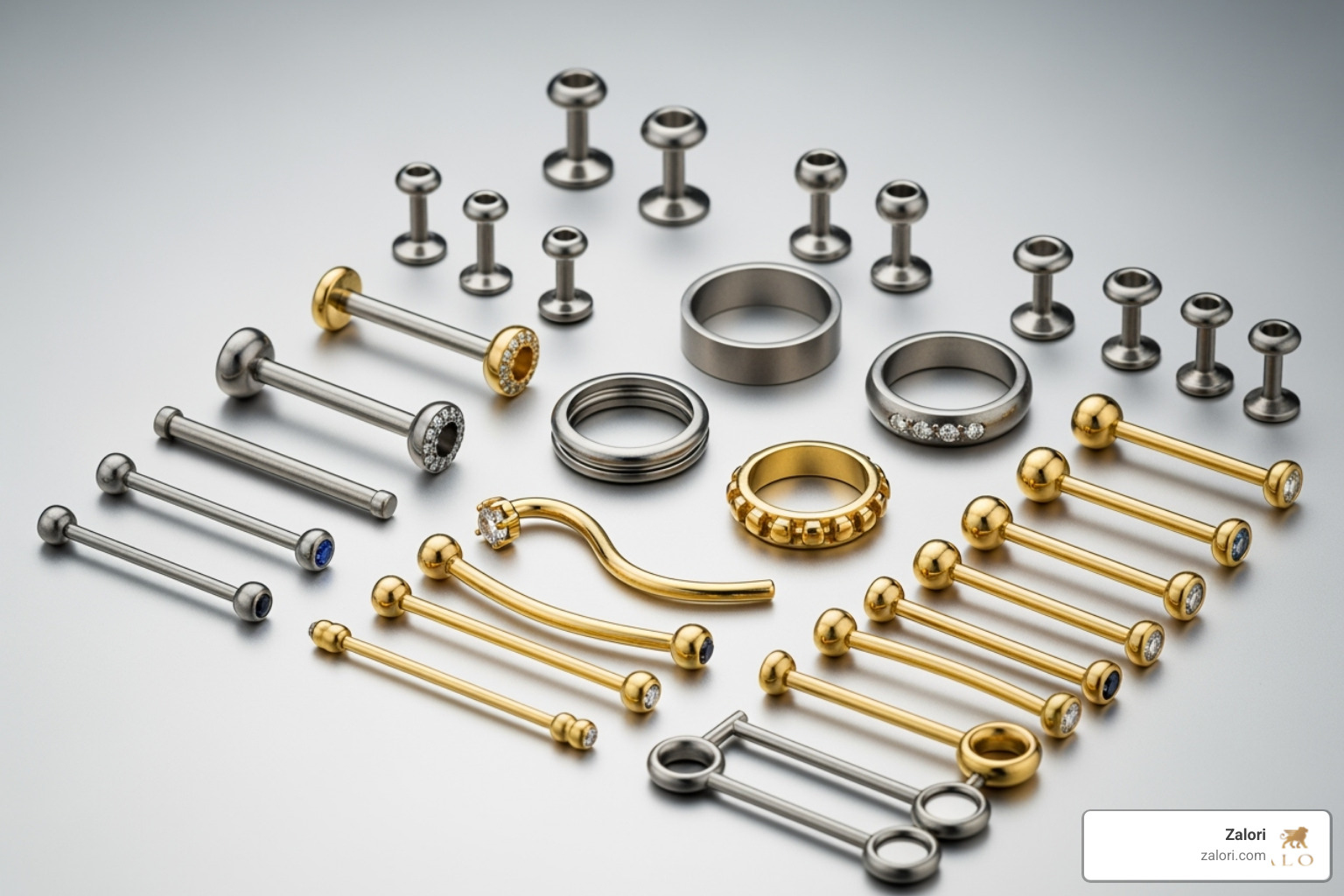
Implant-Grade Titanium (ASTM F-136 or ASTM F-67): This is widely considered the gold standard for initial piercings and sensitive skin. Why? Because it's entirely nickel-free, incredibly strong, lightweight, and corrosion-resistant. Many people with sensitive skin choose titanium piercings because this material provides full nickel-free compatibility with human tissue. The body cannot react to this metal since it remains nonreactive, making it one of the safest options for body piercing jewelry. Implant-grade titanium (ASTM-F136) is even designed for medical use and guarantees biocompatibility, often used in surgical implants. For initial piercings, we recommend commercially pure titanium that is ASTM F-67 compliant or Implant Certified Titanium (Ti6Al4V ELI) that is ASTM F-136 compliant or ISO 5832-3 compliant.
Niobium: A close cousin to titanium, niobium is another excellent choice. It's a pure metal, meaning it doesn't rely on alloys that could trigger irritation. Niobium is at least 99.9% pure (999 Niobium), making it highly hypoallergenic. It's also malleable and can be anodized to create beautiful colors without dyes or plating, similar to titanium. While it's slightly heavier than titanium, it's still very comfortable and a fantastic option for those with metal allergies.
Platinum: As a naturally white and incredibly dense precious metal, platinum is highly prized for its luxury and anti-allergy properties. Platinum firmly resists tarnishing and is wonderfully inert, making it extremely biocompatible. Its pure structure, without nickel content, makes it suitable for people with severe metal allergies. The main drawback is its higher cost, but for unparalleled safety and elegance, it's an exceptional choice.
Solid Gold (14k or 18k): When we talk about gold for piercings, we mean solid gold, not plated or filled. Solid gold is generally well-tolerated by sensitive skin, especially 14k and 18k varieties. These karats offer a perfect balance of purity and strength. 14k gold, for example, offers longevity and comfort, and is a good option for sensitive skin. Pure 24k gold is too soft for piercings and can easily scratch or harbor bacteria, so 14k or 18k are preferred for their durability. For more information on choosing the right karat for your jewelry, explore our guide on 14k vs 18k Gold: How to Choose the Right Karat for Your Everyday Jewelry.
These recommended metals are favored because they are either pure elements or alloys specifically formulated to be inert and non-reactive with human tissue. This inertness is key to preventing allergic reactions and ensuring a smooth, healthy healing process for any piercing.
Metals to Approach with Caution
While some metals are excellent choices for piercing metals for sensitive skin, others require a more cautious approach, especially if you have known sensitivities or are getting a new piercing.
Surgical Stainless Steel (SSS): This is a common and affordable material used for many piercings, but it comes with a caveat. While often referred to as "hypoallergenic," surgical stainless steel does contain nickel, typically 8-16%. For most people, this amount is bound tightly within the alloy and doesn't leach out enough to cause a reaction. However, if you have a known nickel allergy or hypersensitivity, surgical stainless steel may still irritate your skin. We generally recommend it for healed piercings for those who don't react to it, but for a first piercing, especially if you suspect sensitivity, it's best to switch to titanium. Grades like 316L and 316LVM (which indicates vacuum melting for a smoother finish) are preferred for body jewelry, but even these can be problematic for very sensitive individuals.
Sterling Silver: This popular metal is beautiful, but it's generally not recommended for new piercings or for continuous wear in sensitive areas. Sterling silver is typically made from 92.5% silver and 7.5% other metals, most commonly copper, but sometimes also nickel. The copper content can cause skin reactions for some individuals. More importantly, sterling silver oxidizes when exposed to air and bodily fluids, which can lead to discoloration of the jewelry and even cause permanent staining (argyria) of the skin around the piercing. For these reasons, we advise against sterling silver for initial piercings and suggest it's best reserved for external, non-piercing jewelry if you have sensitive skin.
Problematic Piercing Metals for Sensitive Skin to Avoid
To ensure a healthy piercing journey and avoid uncomfortable reactions, there are certain metals you should steer clear of entirely, especially if you have sensitive skin. These materials are frequent culprits for irritation, allergic reactions, and even infection.
Gold-Plated & Gold-Filled Jewelry: While these might look like solid gold and be more affordable, they are a definite no-go for piercings, particularly new ones. Gold-plated jewelry has a thin layer of gold applied over a base metal, which often contains nickel or copper. Gold-filled jewelry has a thicker layer, but the principle is the same. The plating can wear off over time due to friction, sweat, and cleaning, exposing the reactive base metal underneath. This can quickly lead to irritation, allergic reactions, and even infection. For a comprehensive comparison, check out our guide on Gold Vermeil vs. Gold Filled vs. Solid Gold and Sterling Silver: The Clear No-Regrets Jewelry Guide.
Low-Karat Gold (Below 14k): While solid 14k and 18k gold are excellent choices, lower karat gold, such as 10k or 9k, contains a higher percentage of other metals in its alloy. These additional metals are often copper, silver, or sometimes nickel, which can increase the likelihood of an allergic reaction for sensitive individuals.
Copper & Brass: These metals are notorious for causing skin discoloration (often a green or black stain) due to oxidation when exposed to air and moisture. Beyond the aesthetic issue, both copper and brass can trigger allergic reactions, leading to redness, itching, and irritation. They are not biocompatible and should never be used in piercings, especially new or sensitive ones. Research has even revealed potential skin toxicity caused by certain copper compounds.
Mystery Metals & Costume Jewelry: If you don't know the exact composition of a piece of jewelry, it's safest to assume it contains problematic alloys. Inexpensive jewelry products often feature nickel, tin, zinc, or brass. These "mystery metals" or costume jewelry pieces are almost guaranteed to cause irritation, stall healing, or lead to allergic reactions for anyone with sensitive skin. Avoid them entirely for piercings.
Non-Metal Alternatives for Extreme Sensitivities
For those with extreme metal sensitivities or allergies to even the most biocompatible metals, non-metal materials offer a safe and suitable alternative. These options are particularly useful for initial piercings or when you need a flexible, discreet piece.
PTFE (Polytetrafluoroethylene) & BioFlex: These are medical-grade plastics that are incredibly flexible, lightweight, and completely metal-free. They are excellent choices for initial piercings because they are non-reactive and can reduce pressure on healing tissue. PTFE and BioFlex are also ideal for individuals who are completely allergic to metal, or for situations where you need to keep a piercing open discreetly (e.g., for medical procedures or certain professions). While they are fantastic for initial healing, their flexible and sometimes porous nature means they are generally recommended for short-term wear or specific situations rather than permanent jewelry, as they can scratch and potentially harbor bacteria over long periods.
Borosilicate Glass: This is a high-quality, non-porous, and inert material that is entirely safe for piercings. Borosilicate glass is completely metal-free and hypoallergenic, making it an excellent option for sensitive skin, especially for initial piercings or stretches. It's smooth, easy to clean, and comes in a variety of colors. We always recommend choosing borosilicate glass from reputable suppliers.
These non-metal materials provide comfort and safety, offering peace of mind when traditional metals pose a risk. They underscore the fact that there are always options for beautiful, safe body adornment, even for the most sensitive skin.
Your Checklist for Choosing Safe Piercing Jewelry
Navigating piercing jewelry can feel overwhelming, especially when you're prioritizing piercing metals for sensitive skin. To make informed choices and protect your health, we've put together a comprehensive checklist.

Source from Reputable Suppliers: This is perhaps the most crucial step. Sadly, many manufacturers or retailers prioritize profit over safety, using cheaper metals or alloys that look similar to high-quality ones. Always ask what you are buying and choose suppliers who are transparent about their materials and care about your health. Avoid generic online marketplaces that don't provide clear material specifications.
Consult Your Piercer: Your professional piercer is an invaluable resource. They have extensive knowledge of different materials, healing processes, and potential reactions. Talk to your piercer about the best materials for your skin, especially if you have known sensitivities or are getting a new piercing.
Check for Certifications (ASTM, ISO): For metals like titanium and surgical stainless steel, look for certifications. For titanium, this means ASTM F-136 or ISO 5832-3 compliant implant-grade titanium. For surgical stainless steel, look for 316L or 316LVM. These certifications guarantee that the material meets strict standards for quality, biocompatibility, and safety, minimizing the risk of harmful trace elements.
Prioritize Implant-Grade for New Piercings: For any new piercing, always opt for implant-grade materials. This includes implant-grade titanium, niobium, platinum, or solid 14k/18k gold. These materials are designed to be accepted by the body without adverse reactions, promoting optimal healing.
Choose Solid Metals Over Plated: We cannot stress this enough: never wear gold-plated, silver-plated, or gold-filled jewelry in a piercing. The plating will eventually wear off, exposing potentially irritating base metals like nickel or copper. Invest in solid, high-quality metals for lasting comfort and safety.
Inspect for a Mirror-Smooth Finish: The surface quality of your jewelry is just as important as the material itself. Jewelry for piercings, especially initial ones, should be mirror-polished and free of nicks, scratches, or rough edges. A smooth finish prevents friction, reduces the chance of bacteria clinging to the surface, and minimizes irritation to the delicate healing tissue. Ensure titanium jewelry is internally threaded or threadless for optimal smoothness.
By following this checklist, you'll be well-equipped to choose jewelry that is both beautiful and safe for your piercing metals for sensitive skin. We encourage you to explore our collection of high-quality jewelry designed with these rigorous standards in mind.
Frequently Asked Questions about Piercing Metals
We often hear similar questions from our customers about piercing metals for sensitive skin. Let's address some of the most common concerns to help you make the best choices for your body.
Can I suddenly develop an allergy to a metal I've worn before?
Yes, absolutely. It might seem strange, but it's quite common for skin allergies to develop at any age, even if you've worn a particular metal for years without issue. This often happens from "over-exposure" to certain metals, like nickel. Your immune system can gradually become sensitized over time, and then one day, it decides to react. You might notice symptoms like redness, itching, or a rash appearing 12-48 hours after wearing jewelry that used to be fine. This is why it's crucial to always listen to your body and change your jewelry if any irritation begins.
Is "hypoallergenic" jewelry guaranteed to be safe?
Unfortunately, no. The term "hypoallergenic" is largely unregulated in the jewelry industry. It generally means "less likely" to cause an allergic reaction, not that it's impossible. A manufacturer might label something as hypoallergenic because it has a lower nickel content, but it could still contain enough to trigger a reaction in someone with extreme sensitivity. The key is to know the specific material composition. Always look for clearly stated materials like "implant-grade titanium," "999 niobium," "solid 14k gold," or "platinum," rather than relying solely on a generic "hypoallergenic" label.
What's the difference between solid gold and gold-plated for piercings?
This is a critical distinction, especially for piercings.
Solid Gold: As the name suggests, solid gold jewelry is made entirely of gold alloy throughout. For piercings, we recommend 14k or 18k solid gold. These karats indicate the proportion of pure gold (24 parts being pure) to other metals in the alloy. For example, 14k gold is 14 parts gold and 10 parts other metals, making it durable enough for everyday wear while retaining high purity. Our 14k gold pieces are even crafted from 94% recycled material, reflecting our commitment to quality and sustainability. Solid gold is generally very well-tolerated by sensitive skin because the gold itself is inert.
Gold-Plated: Gold-plated jewelry consists of a very thin layer of gold applied over a base metal, which is often brass, copper, or even nickel. This thin gold layer can easily wear off due to friction, sweat, and cleaning. Once the plating is compromised, the underlying base metal is exposed to your skin and piercing, which can quickly lead to irritation, allergic reactions, and even infection. For this reason, gold-plated jewelry should never be used in piercings, new or healed. For more detailed insights into the differences and why solid gold is always superior for piercings, read our article on Gold Vermeil vs. Gold Filled vs. Solid Gold and Sterling Silver: The Clear No-Regrets Jewelry Guide.
Conclusion
Choosing the right piercing metals for sensitive skin is more than just a preference; it's a fundamental aspect of comfort, health, and style. We've seen how common issues like redness, itching, and prolonged healing often stem from reactive metals, with nickel being the primary culprit. Understanding the signs of a metal allergy and knowing which materials to trust can transform your piercing experience.
Remember our top recommendations for sensitive skin:
- Implant-grade Titanium: The ultimate biocompatible, nickel-free choice for new and healed piercings.
- Niobium: A pure, hypoallergenic alternative, offering great flexibility.
- Platinum: The luxurious, inert option for high-end safety and durability.
- Solid Gold (14k or 18k): A beautiful and safe choice, provided it's solid and not plated.
We urge you to approach metals like surgical stainless steel with caution and to completely avoid problematic materials such as gold-plated jewelry, low-karat gold, copper, brass, and any "mystery metals." For extreme sensitivities, non-metal alternatives like PTFE/BioFlex and borosilicate glass offer excellent, safe options.
At Zalori, we believe that exceptional craftsmanship and authentic, high-quality materials are non-negotiable. Our commitment to these standards means you never have to compromise your health for your style. Investing in quality piercing metals for sensitive skin is an investment in your long-term comfort and the lasting beauty of your adornments.
To understand more about our uncompromising material standards and what sets our jewelry apart, we invite you to Learn more about our material standards. And if you're ready to find the perfect piece that combines luxury with ultimate skin safety, explore our curated selection designed specifically for your needs: Find the perfect piece for your sensitive skin.
Related Articles
View all