Beyond Cultured: Discovering the Magic of Natural Pearls
Why Natural Pearls Represent the Pinnacle of Organic Luxury
Natural pearls are organic gems formed entirely by nature, without any human intervention, making them among the rarest and most valuable gemstones in the world. Here's what sets them apart:
What Makes Natural Pearls Unique:
- Formation: Created when a mollusk accidentally encounters an irritant and coats it with layers of nacre over many years
- Rarity: It can take more than 100,000 wild oysters to produce just one strand of natural pearls
- Value: A natural pearl of equal size and quality can be 100 times more expensive than a cultured pearl
- Composition: Nearly 100% calcium carbonate and conchiolin, with concentric growth rings throughout
- Availability: Most ocean natural pearls have already been harvested; today they're found primarily in museums and estate collections
For centuries, pearls have symbolized beauty and wealth. Historical figures adorned themselves with these treasures—from the Crown Jewels to celebrity auctions where pearl jewelry breaks records. The very rarity that made them comparable to real estate centuries ago still defines their extraordinary value today.
Unlike cultured pearls, created through deliberate human intervention, natural pearls form spontaneously in the wild. This distinction isn't just academic—it's the difference between finding a perfect diamond in a riverbed and growing one in a lab. Both are real, but only one carries the mystique of pure chance.
The story of natural pearls is ultimately one of scarcity meeting perfection. Pearl divers once risked their lives searching through thousands of oysters for a single gem. Today, with most natural pearl beds depleted, these organic treasures have become even more exclusive.
I'm Eric Roach Zalori, and my work in fine jewelry has shown me that discerning collectors seek authentic pieces with lasting value—qualities embodied perfectly in natural pearls. My commitment at Zalori is to provide genuine, high-quality materials that are real investments, not mass-produced alternatives.
The Genesis of a Gem: How Natural and Cultured Pearls Are Formed
Every pearl begins with a mollusk's natural defense. When a foreign object enters its shell, the creature wraps the intruder in layer after layer of nacre—the lustrous material that lines its shell. Over years, these layers accumulate, changing an irritant into a beautiful gem.
But here's where the paths diverge between natural pearls and their cultured counterparts.
Natural pearl formation is entirely accidental. An irritant—like a parasite or organic debris (rarely a grain of sand)—finds its way inside a wild mollusk. The creature forms a "pearl sac" around it and deposits concentric layers of nacre, ring by ring. This process occurs with no human intervention, purely as an act of nature.
Cultured pearl formation follows the same biological process, but it's initiated by a human. Pearl farmers carefully insert a bead nucleus into a host mollusk, mimicking the natural accident. The mollusk is returned to the water, where it coats the irritant with nacre just as it would in the wild. The distinction comes down to that initial spark—chance versus planned intervention.
For a deeper look at the fascinating biology behind these gems, The Smithsonian offers an excellent explanation of how pearls are truly made. And if you're curious about the different varieties of cultured pearls available today, our Pearl Primer explores South Sea, Akoya, and other statement varieties in detail.
What makes natural pearls a miracle of nature?
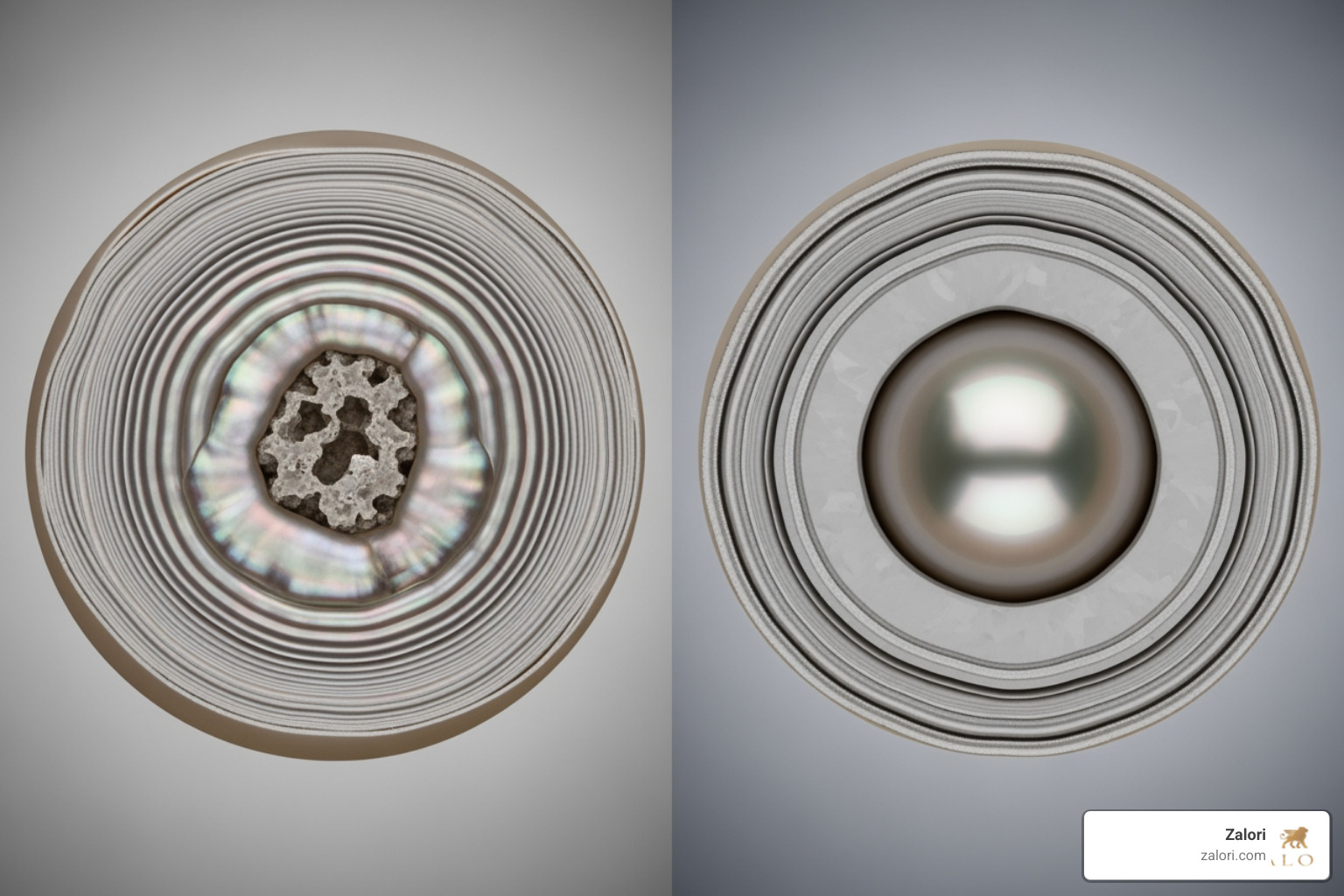
The word "miracle" fits natural pearls because they form spontaneously in the wild, a one-in-thousands event of pure chance. When gemologists examine a natural pearl under X-ray, they see its true identity: concentric growth rings radiating from a tiny organic core, much like tree rings. This internal structure—nacre all the way through—sets them apart from most bead-nucleated cultured pearls, which show a solid bead at their center. Composed almost entirely of calcium carbonate and an organic protein "glue" called conchiolin, their pure composition is why natural pearls are considered extraordinary creations of the natural world.
Are cultured pearls considered 'real' pearls?
Yes, cultured pearls are absolutely real pearls, a fact confirmed by gemological authorities like the GIA and the FTC. A pearl is defined by its nacre composition secreted by a mollusk, which both types meet. Once the process begins, the biology is identical; the mollusk creates the same lustrous gem regardless of how the irritant got there. Before the 1900s, pearls were reserved for royalty. Pearl farming made these beautiful gems accessible to far more people while helping to preserve wild oyster populations. When you wear a cultured pearl from Zalori, you're wearing a genuine gem created by the same miraculous process that has fascinated humans for millennia.
The Rarity and Enduring Value of Natural Pearls
The extraordinary value of natural pearls is about scarcity on an unimaginable scale. For centuries, divers risked everything to harvest these rare gems, which nature creates with incredible infrequency.
Historically, oceans and rivers from the Persian Gulf to the Mississippi River held abundant pearl beds. These legendary sources seemed inexhaustible, but relentless over-harvesting, pollution, and habitat destruction devastated these once-thriving populations. Today, most historical sources are either completely depleted or protected by strict conservation laws.
The statistical reality of finding a natural pearl is staggering: it could take more than 100,000 wild oysters to produce just one single strand of matching pearls. In a typical haul of three tons of oysters, perhaps only three or four perfect pearls would emerge. The odds of finding enough matching pearls to create a necklace are astronomical.
The human cost was also staggering. Historical pearl divers descended 48 to 120 feet in dangerous open waters, facing sharks, currents, and the risk of drowning. This perilous profession, detailed in Dangers of diving for pearls, is now largely obsolete. The severe physical toll on divers adds a somber note to the history of these gems.

Today, the value comparison reflects this extreme rarity. A natural pearl of equal size and quality can command a price 100 times higher than a comparable cultured pearl. Most of the ocean's natural pearls have already been harvested, meaning they are no longer commercially viable for new jewelry production.
Instead, natural pearls exist in a rarified field. They grace museum collections, appear in prestigious auctions, and adorn historical treasures like the Crown Jewels. Their enduring value is rooted in the impossibility of finding them today. You cannot commission a natural pearl necklace; you can only acquire one that already exists. This profound scarcity, combined with their organic perfection and historical significance, ensures natural pearls remain among the world's most coveted gemstones.
Judging a Pearl's Soul: The 7 Factors of Quality
Whether admiring a natural pearl or a cultured one, we judge its beauty and value using the same criteria. The Gemological Institute of America (GIA) established seven key value factors that define a pearl's quality. At Zalori, we apply these same exacting standards, a commitment detailed in Crafted to Perfection: Understanding What Makes a Product Truly High Quality.
Size: Measured in millimeters, larger pearls are generally rarer and more valuable. It is difficult for a mollusk to maintain high quality over the extended growth period required for large sizes, such as South Sea pearls (9-20mm) compared to Akoyas (2-10mm).
Shape: While wonderfully irregular baroque pearls have their own charm, a perfectly round sphere remains the most prized and classic shape. Other common shapes include semi-round, button, pear, and oval.
Color: This includes the pearl's main bodycolor (e.g., white, cream, black), a translucent overtone (e.g., rose), and orient—an iridescent rainbow shimmer. The most valuable pearls display even color distribution.
Luster: Arguably the most important factor, luster is the brilliance and sharpness of reflections on the pearl's surface. High-luster pearls appear mirror-like, a quality derived from thick, translucent nacre layers.
Surface Quality: A valuable pearl should have a smooth, clean surface with as few blemishes (like pits or bumps) as possible. Completely flawless pearls are exceptionally rare, so the fewer the imperfections, the higher the value.
Nacre Quality: This refers to the thickness of the nacre layers, which directly impacts a pearl's luster and durability. Thicker nacre ensures a lasting glow and a gem that can be passed down for generations.
Matching: For multi-pearl jewelry, this assesses the uniformity of all pearls across the other six value factors. Creating a perfectly matched strand is an art, sometimes requiring sorting through thousands of pearls.
Understanding these seven value factors gives you a new appreciation for every pearl you encounter, celebrating the remarkable artistry—whether nature's or a skilled farmer's—that brought it into being.
A Collector's Guide: Identifying Pearls and Exploring Varieties
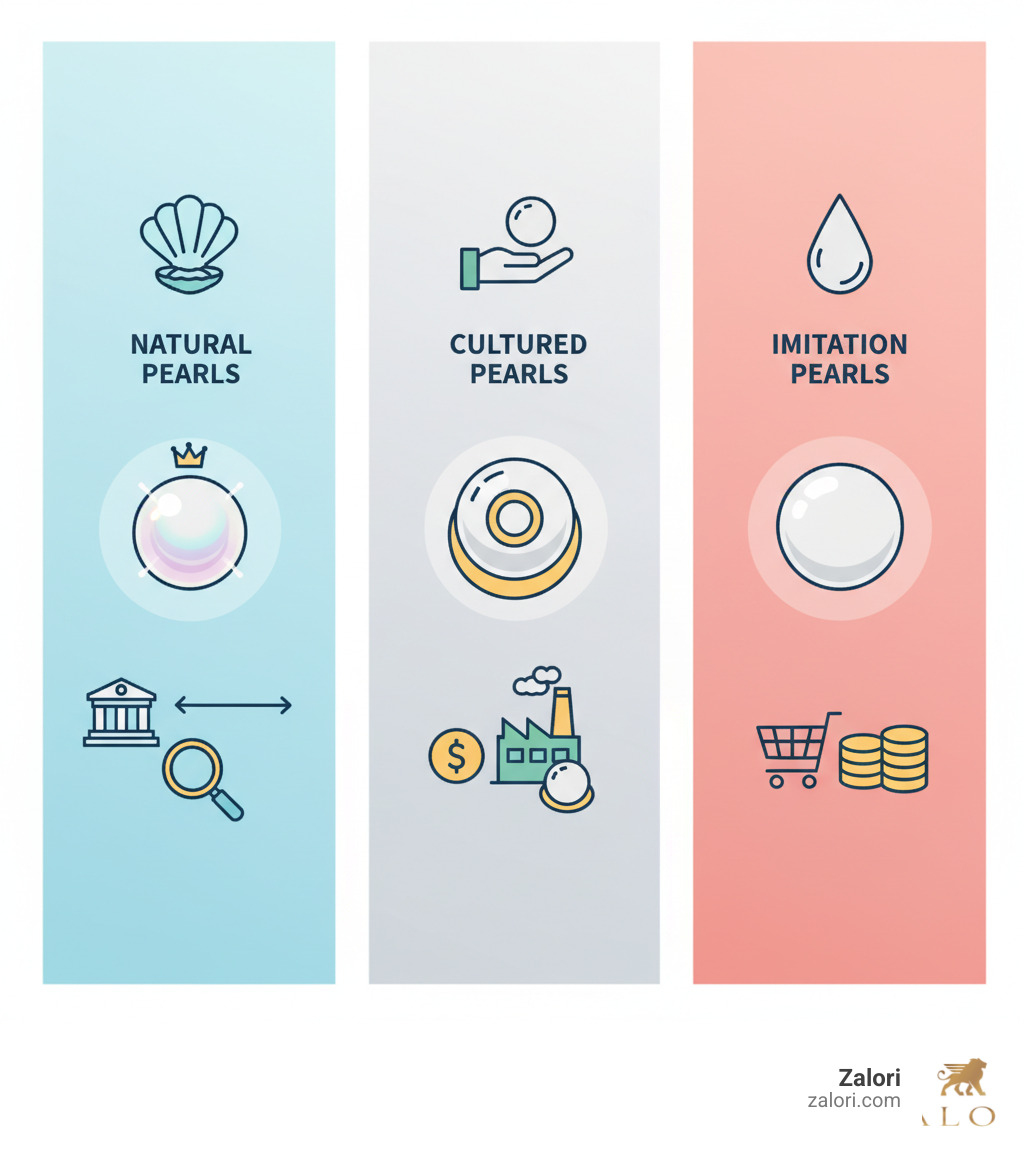
Knowing the difference between natural pearls, cultured pearls, and imitations is essential for any collector. At Zalori, we believe understanding these distinctions empowers you to make confident choices.
Distinguishing Between Natural Pearls, Cultured, and Imitations
Even experienced gemologists can't reliably tell natural pearls from cultured ones just by looking. The differences are hidden, requiring specialized testing.
X-ray examination is the gold standard. A natural pearl reveals concentric growth rings radiating from its tiny organic center, while bead-nucleated cultured pearls show a solid bead at their core. For distinguishing genuine pearls from imitations, the "tooth test" is a simple trick: real pearls feel slightly gritty against a tooth due to their nacre structure, while imitations feel perfectly smooth. Genuine pearls also possess a depth of luster and an inner glow that imitations struggle to replicate.
For additional guidance on authenticating your gemstone jewelry purchases, especially when shopping online, we've created a comprehensive resource: Beyond the Bling: Finding Your Authentic Stone Jewelry Online.
A Glimpse into the World of Cultured Pearls
While natural pearls remain elusive, cultured pearls offer a world of variety.
- Akoya pearls: The classic Japanese pearl, celebrated for perfectly round shapes and mirror-like luster in white or cream with delicate overtones.
- South Sea pearls: The giants of the pearl world, known for their large size (9-20mm), thick nacre, and soft, satiny luster in white, silver, or gold.
- Tahitian pearls: Famed as "black pearls," they occur in a stunning spectrum of dark shades, including gray, blue, green, and the coveted iridescent "peacock."
- Freshwater pearls: Cultivated in mussels, they offer incredible versatility in shape, size, and natural pastel colors, making them an accessible and popular choice. For a deeper exploration, check out our Freshwater Pearls Decoded: The 2025 Buying & Care Guide.
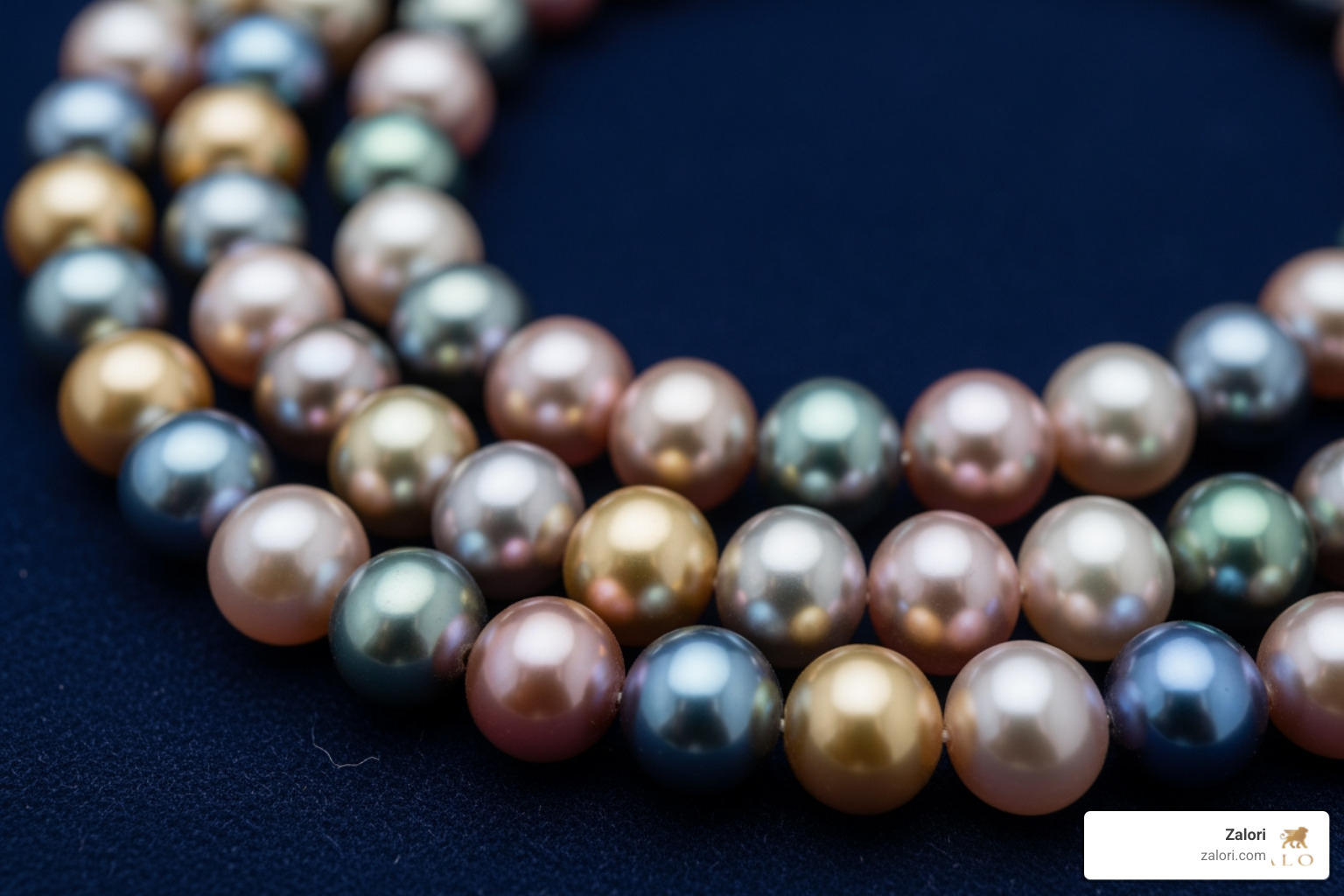
Beyond the Oyster: Unique and Exotic Natural Pearls
Some of the most fascinating natural pearls are non-nacreous, displaying a porcelain-like luster.
- Conch pearls: Produced by the Queen conch, these pink-to-orange gems are famous for their "flame structure" pattern. They cannot be cultured, making them exceptionally rare.
- Melo Melo pearls: From large sea snails, these orange-to-tan pearls also exhibit a flame structure and cannot be cultured, placing them among rare natural treasures.
- Abalone pearls: Found in abalone mollusks, these pearls showcase spectacular iridescent colors—vibrant mixes of blue, green, and purple in irregular baroque shapes.
These exotic natural pearls remind us that nature's creativity knows no bounds, representing the ultimate collector's items.
Frequently Asked Questions about Natural Pearls
When it comes to natural pearls, we're often asked about what makes them so different—and why they command such remarkable prices. Here are answers to the most common questions.
Why are natural pearls so much more expensive than cultured pearls?
The price difference is staggering because of three factors. First is extreme rarity; it can take over 100,000 wild oysters to produce a single strand. Second, the dangers of historical pearl diving add to their storied value, as divers risked their lives for these gems. Finally, natural pearls are true collector's items. With most pearl beds depleted, they are no longer commercially harvested and exist primarily in auctions and estate collections, driving their value far beyond that of cultured pearls.
Can you still buy natural pearls today?
Yes, but you won't find them in a typical jewelry store. Natural pearls are primarily found in the secondary market: in antique jewelry, at estate sales, and through specialized auctions. A select number of expert gem dealers also source them. Acquiring a natural pearl means entering the collector's market to find a piece of history, not commissioning a new item.
How can I be sure a pearl is natural?
Visual inspection alone is not enough. The only reliable method is gemological testing by a certified laboratory like the GIA. They use X-ray radiography to reveal the pearl's internal structure. A natural pearl shows concentric growth layers from its core, while a bead-nucleated cultured pearl will show the implanted sphere. Given the significant price premium, insisting on a reputable gemological certificate is essential to protect your investment and ensure you are acquiring a genuine natural pearl.
Conclusion: The Timeless Legacy of Nature's Gem
There's something magical about natural pearls—gems that form entirely by chance, without a single human hand guiding their creation. When so much is manufactured, they remind us that nature still holds secrets worth celebrating.
We've explored what makes natural pearls so extraordinarily rare and valuable, from their spontaneous formation to the seven factors that define their quality. Their story is one of pure rarity meeting absolute perfection. Most of the world's natural pearls have already been harvested, and what remains exists primarily in historical collections and estate jewelry. This scarcity only deepens their mystique.
At Zalori, we share this profound appreciation for authenticity. While natural pearls are rarely available, our commitment to uncompromising standards means we apply the same reverence to selecting the finest cultured pearls and genuine materials for our collections. We understand that our clients seek jewelry that represents real value—pieces crafted with integrity that will be cherished for years to come.
The legacy of natural pearls is a testament to what happens when time, chance, and biology converge in perfect harmony. Their story continues to inspire us, reminding us why authenticity matters and why some treasures simply cannot be replicated.
Whether you're drawn to the timeless elegance of cultured pearls or fascinated by the history of their natural counterparts, we invite you to explore beauty that endures. Explore our curated pearl collections and discover the perfect piece of timeless elegance. And for those eager to deepen their knowledge, learn more about the different types of pearls in our comprehensive Pearl Primer.
Related Articles
View all